
Saint-Contest, France – 17/03/2026
ADCIS today announced the release of a new Neuroma Module within ARIES, its flagship software solution for automated analysis of confocal microscopy images of the cornea. This new module has been developed by Singapore Eye Research Institute and integrated by ADCIS as part of their long-term, multi‑year strategic partnership, further strengthening their collaboration in ophthalmic image analysis and clinical research.
The ARIES Neuroma Module introduces an advanced deep learning–based approach for the automatic detection, segmentation, and quantification of corneal neuromas. Trained on thousands of corneal in‑vitro confocal microscopy images and clinically validated, the module delivers fast, objective, and reproducible measurements of neuroma morphological characteristics, reducing analysis time from minutes to seconds while improving consistency across studies.
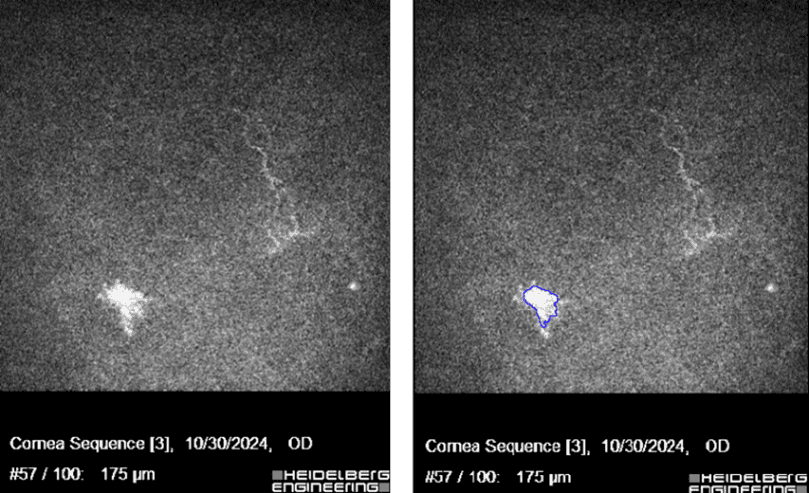
Fully integrated into the ARIES software environment, the Neuroma Module enhances diagnostic confidence and supports longitudinal follow‑up in both research and clinical settings. It is designed to address the needs of research groups, pharmaceutical companies, biotechnology organizations, and physicians working on the epithelial layer of the cornea, where precise and reliable nerve analysis is critical.
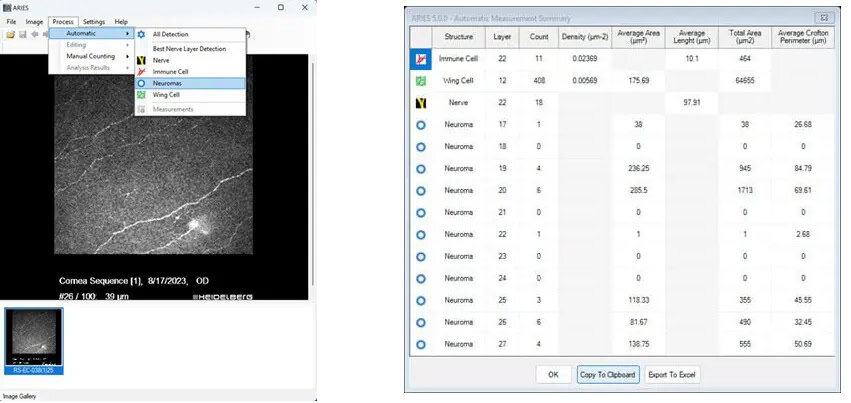
Corneal microneuromas are increasingly recognized as key biomarkers for a range of ocular and systemic conditions. The new module facilitates:
- Early and reproducible screening of neuropathic corneal pain
- Objective monitoring of nerve regeneration and post‑surgical neuropathic complications
- Detection of nerve damage related to inflammatory processes
- Systematic, quantitative screening of the corneal nerve network for differential diagnosis
These capabilities make the ARIES Neuroma Module particularly well suited for clinical research, pharmaceutical studies, and screening programs, where reproducibility and scalability are essential.
ADCIS commitment to advanced ophthalmological diagnosis through AI
“This deep learning-based algorithm allows for the automated detection, segmentation, and quantification of corneal neuromas in a reliable and accurate way. This technology is clinically relevant as corneal neuromas correlate with clinical symptoms, such as eye pain or light sensitivity. Being able to quantify neuromas objectively and quickly provides a valuable means to monitor disease severity and treatment effectiveness better. It offers a valuable tool in clinical practice and research.
Associate Professor Yu-Chi Liu, MD, MCI, PhD, Clinician Scientist and Principal Investigator, Singapore National Eye Centre / Singapore Eye Research Institute
“By combining SERI’s clinical and scientific expertise with ADCIS’s deep experience in medical image processing and AI integration, this new module represents a significant step forward in automated corneal nerve analysis. It reinforces ARIES as a comprehensive platform for 2D and 3D corneal analysis and reflects the strength of our long‑standing partnership.”
François Potevin, Director at ADCIS
About us
ARIES (AI Confocal Rapid Image Evaluation System) is a standalone software solution developed by ADCIS for the automated processing and quantitative analysis of corneal confocal microscopy images. It enables automatic detection and measurement of nerves, immune cells, epithelial cells, and now neuromas, with optional manual editing to support high‑precision workflows in both clinical and research environments.
About ADCIS
ADCIS is a French software company specializing in advanced image processing and image analysis solutions for industrial and medical applications.
About Singapore Eye Research Institute
Established in 1997, Singapore Eye Research Institute (SERI) is Singapore’s national research institute for ophthalmic and vision research. SERI’s mission is to conduct high-impact eye research that prevents blindness, low vision and major eye diseases common to Singaporeans and Asians. Over the last decade, SERI has conducted land-mark research projects that have led to tangible outcomes, patient benefits, and success stories. It has paved the way for significant improvements in how eye diseases are treated and prevented, not just for Singaporeans or Asians, but on a global scale.
At its inception, SERI saw a national remit in ophthalmic and vision research. SERI has grown from a founding team of five in 1997 to a faculty of more than 250 staff, encompassing clinician scientists, scientists, research fellows, PhD students and support staff. This makes SERI one of the largest research institutes in Singapore, as well as the largest eye research institute in the Asia Pacific region. SERI has also over 250 adjunct faculties from various eye departments, biomedical institutes and tertiary centres in Singapore. SERI has published an impressive array of 5,942 scientific papers and has secured external peer-reviewed competitive grants. As of December 2024, SERI’s faculty has been awarded with more than 1,425 national and international prizes and filed 188 patents.
As the research institute of the SNEC, and directly affiliated to the Yong Loo Lin School of Medicine, National University of Singapore, as well the Duke-NUS Medical School, SERI undertakes vision research in collaboration with local clinical ophthalmic centres and biomedical research institutions, as well as major eye centres and research institutes throughout the world. SERI ranks first globally in terms of eye publications per capita, far ahead of the US, UK and Japan. SERI is also ranked 1st in Ophthalmology among all non-academic institutes, and 2nd in ophthalmology among all institutes in ScholarGPS®. With its impressive publication track record, SERI is comparable to renowned eye institutes, both regionally and internationally.
17/03/2026 – ADCIS Announces the Release of the New Neuroma Module within ARIES Software