
Fuchs Endothelial Corneal Dystrophy is the leading indication for keratoplasty worldwide, affecting up to 7.33% of the adult population. Yet its standard grading tool, the modified Krachmer grade is subjective, coarse, and poorly adapted to clinical trials that need to detect early, measurable change.
Developed in collaboration with Dr. Mark Greiner’s team at the University of Iowa, a wordwilde reference center for FECD research, Gutteye automates the segmentation and quantification of guttae in specular microscopy images. It delivers an objective, reproducible GAR% score that tracks disease progression with unprecedented sensitivity.
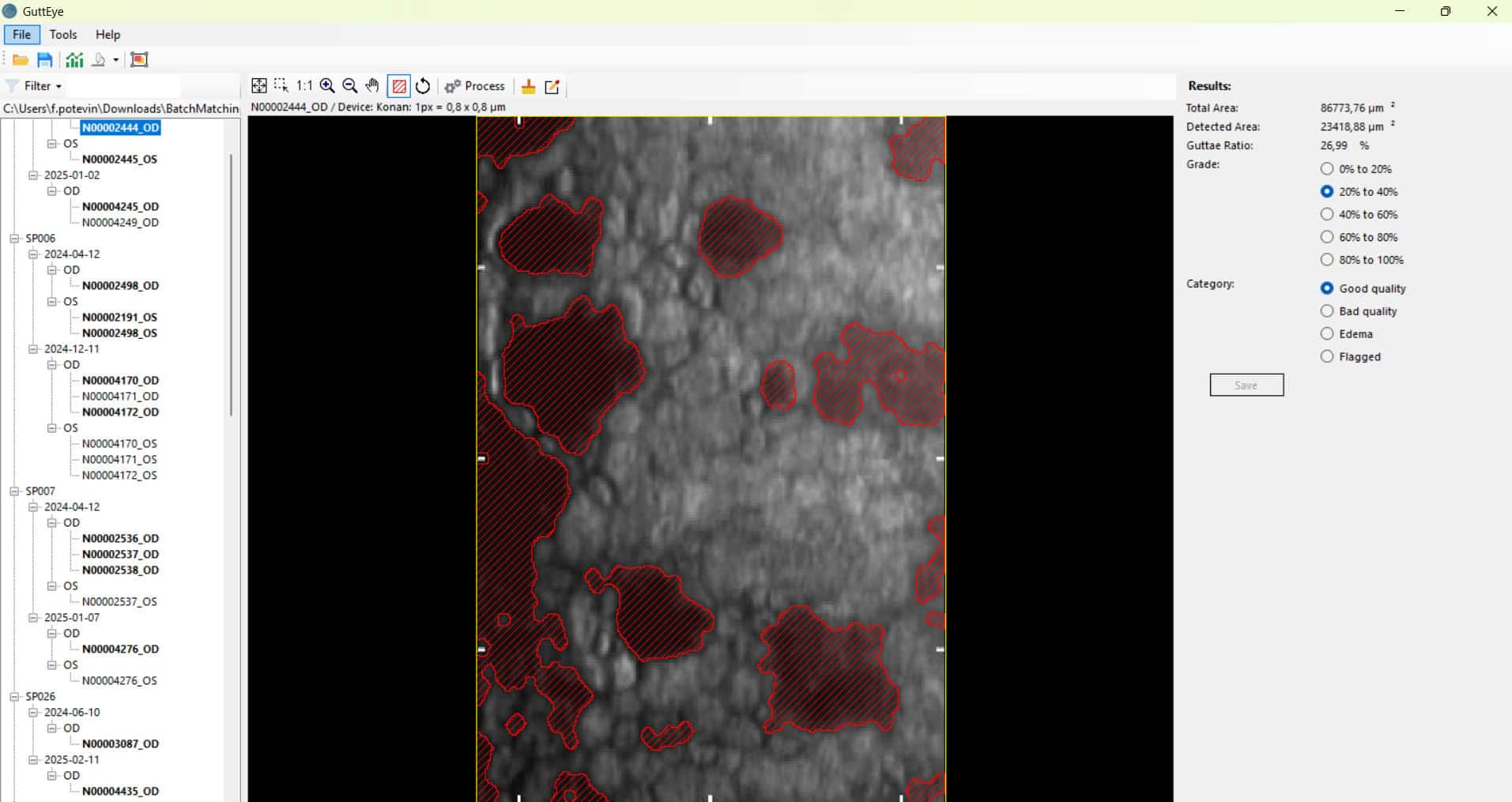
Gutteye automatically segments guttae in specular microscopy imaging to support a sensitive FECD grading and its longitudinal tracking
Benefits of Gutteye for CROs and pharmaceutical companies
Many research groups have been working for several years on new treatments for Fuchs’ dystrophy, including eye drops, injections, and medications. All of these treatments are now ready to move on to the next phase: clinical studies.
With the modified Krachmer grade, detecting a statistically significant change between treatment and control groups can take up to 10 years. That’s not a clinical trial, that’s a career! Gutteye’s GAR% score detects early, quantified progression in the short term, making it the imaging endpoint clinical trials actually need.
Gutteye is currently being used by CROs and pharmaceutical teams preparing Phase II and III trials for emerging Fuchs dystrophy treatments.
A state of the art application for longitudinal patient monitoring
Gutteye is an up-and-running application that has been designed to cover a large range of professional feature to better grade and trace FECD patients :
- Automated guttae segmentation : analyzes an image in just a few seconds, whereas a manual assessment takes several minutes
- Manual correction tool : override AI output on any image, keeping the expert in control
- GAR% score : a single, quantified metric that replaces subjective mKg grading
- Longitudinal tracking : monitor individual patient progression over months or years with a consistent, comparable metric
- Automatic image alignment : ensures GAR% comparisons are made on the exact same corneal areas across visits
- Cell-level alignment : critical because guttae distribution is not uniform; this makes longitudinal data meaningful
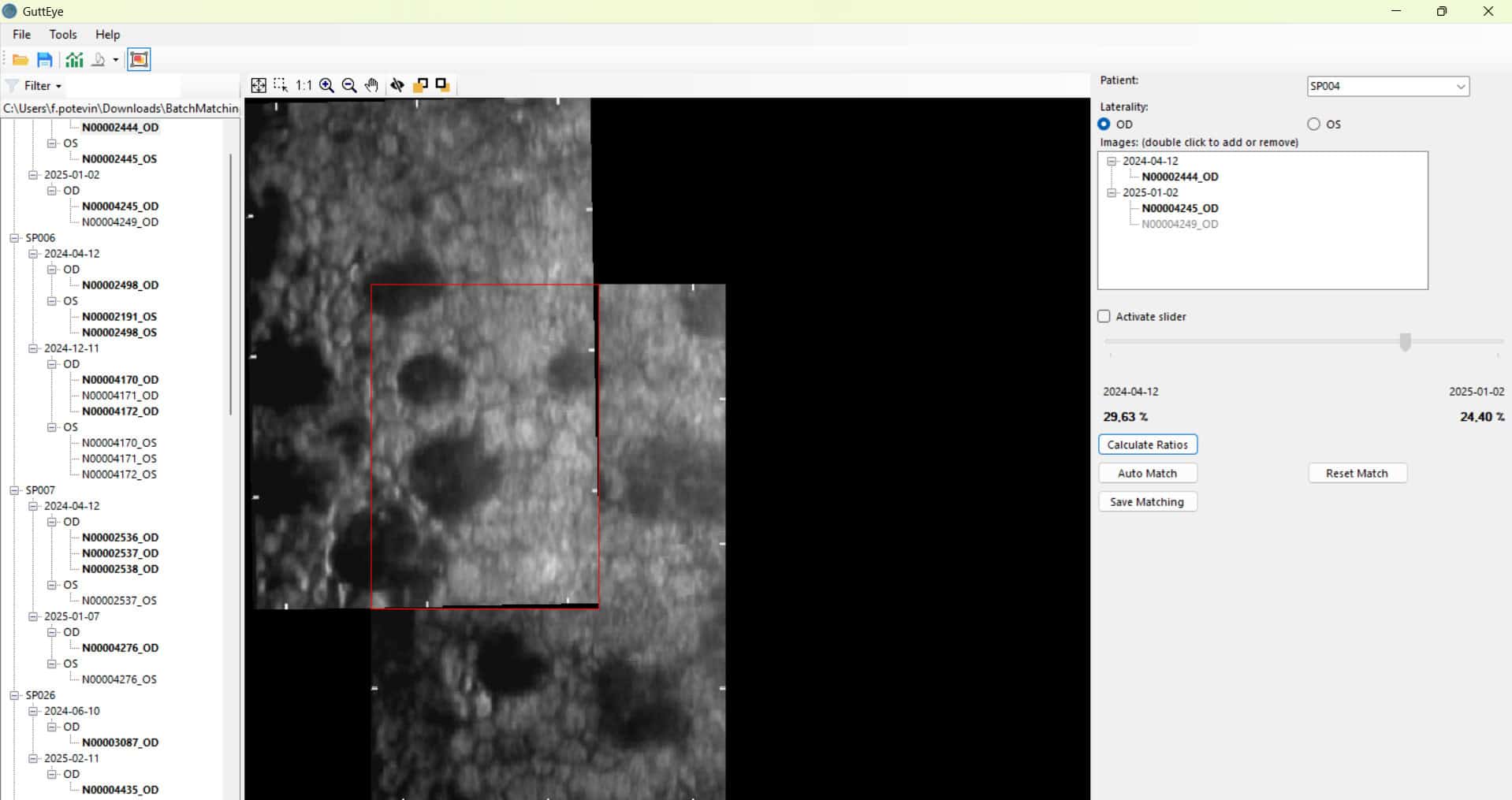
Automatic image allignement : Since guttae are not evenly distributed across the cornea, it is essential to be able to compare the evolution of the GAR% FECD score over time in common cellular areas.
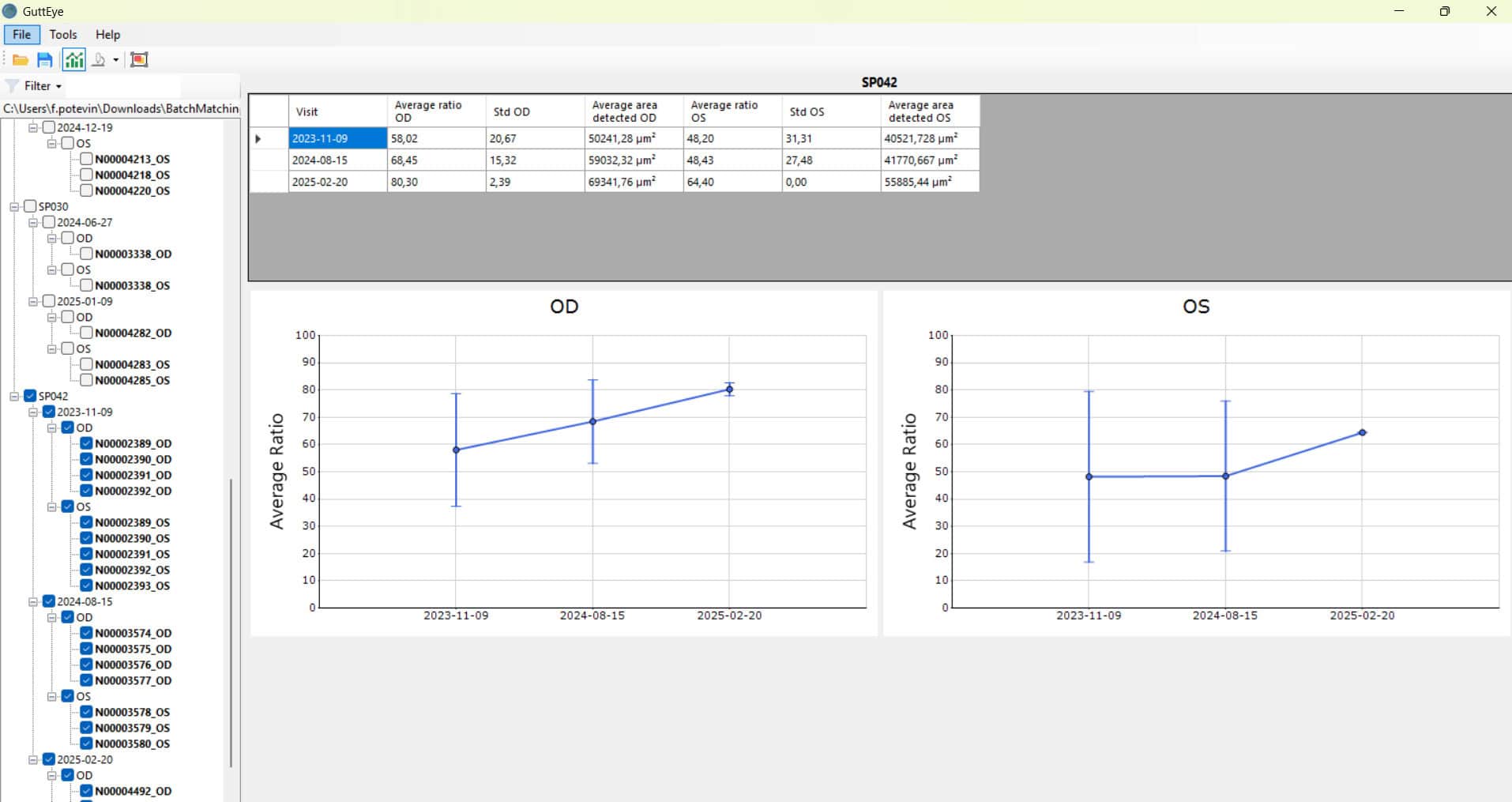
Longitudinal tracking of the GAR% & grading