

Quantitative Grading of Fuchs Endothelial Corneal Dystrophy Powered by AI
GuttEye
Fuchs Endothelial Corneal Dystrophy is the leading indication for keratoplasty worldwide, affecting up to 7.33% of the adult population. Yet its standard grading tool, the modified Krachmer grade is subjective, coarse, and poorly adapted to clinical trials that need to detect early, measurable change.
Developed in collaboration with clinical experts and worldwide references for FECD research, GuttEye automates the segmentation and quantification of guttae in specular microscopy images. It delivers an objective, reproductible GAR% score that tracks disease progression with unprecedented sensitivity.
By transforming specular microscopy images into quantitative clinical data, GuttEye enables more accurate disease assessment, standardized follow-up, and improved evaluation of therapeutic efficacy. Turn subjective grading into measurable clinical evidence.
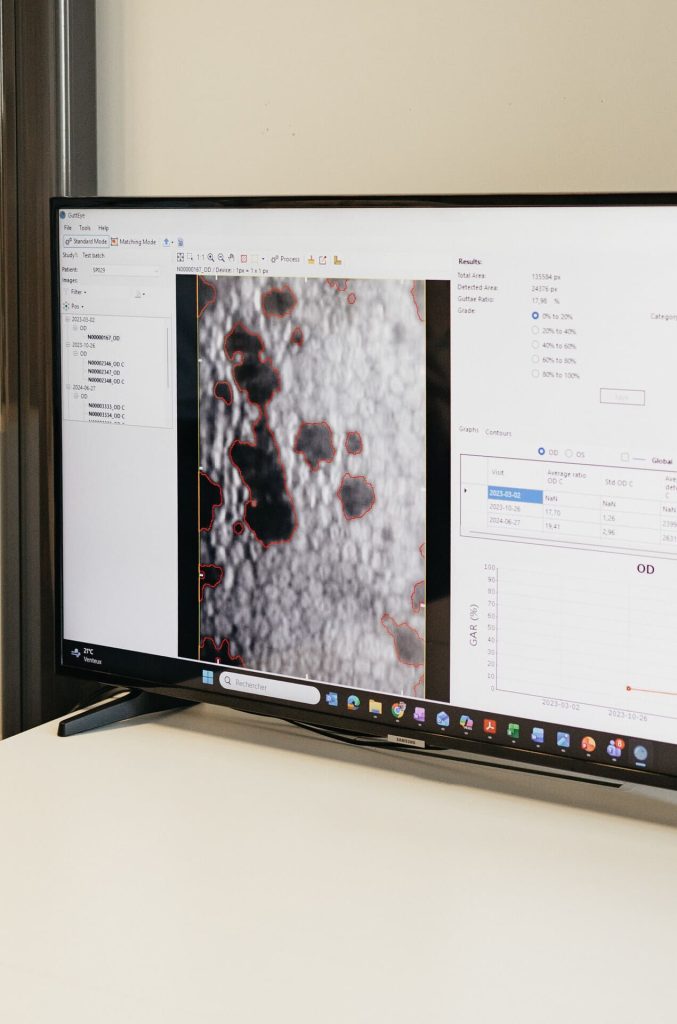
Monitor Disease Progression with Confidence
Traditional FECD grading methods often lack the precision needed to detect subtle changes over time, making patient follow-up and clinical trial evaluation particularly challenging.
GuttEye introduces an objective quantitative approach through its proprietary GAR% score, enabling more sensitive monitoring of disease progression and treatment response.
Our solution helps research groups and clinical practices:
- Standardize FECD grading
- Generate reproducible quantitative endpoints
- Reduce inter- and intra-observer variability
- Monitor disease progression over time
- Support clinical decision-making
- Improve patient follow-up
- Accelerate ophthalmology research
- Facilitate clinical trial assessments
By providing objective measurements instead of subjective observations, GuttEye helps clinicians and researchers make more confident decisions.
Who Benefits from GuttEye ?
A STATE OF THE ART APPLICATION FOR LONGITUDINAL MONITORING OF FUCHS DYSTROPHY
GuttEye is an up-and-running application that has been designed to cover a large range of professional features to better grade and trace FECD patients:
Key Capabilities :
- Automated guttae segmentation : analyze an image in just a few seconds, whereas a manual assessment takes several minutes
- Manual correction tool : override AI output on any image, keeping the expert in control
- GAR% score : a single, quantified metric that replace subjective mKg grading
- Longitudinal tracking : monitor individual patient progression over months or years with a consistent, comparable metric
- Automatic image alignment : ensure GAR% comparisons are made on the exact same corneal areas across visits
- Cell-level alignment : critical because guttae distribution is not uniform; this makes longitudinal data meaningful
The result is a robust and scalable workflow that supports both routine clinical practice and large-scale research projects.
BENEFITS OF GUTTEYE FOR CROs, MEDTECHS AND PHARMACEUTICAL COMPANIES
Many research groups have been working for several years on new treatments for Fuchs’ dystrophy, including eye drops, injections, and medications. All of these treatments are now ready to move on to the next phase: clinical trials.
With the modified Krachmer grade, detecting a statistically significant change between treatment and control groups can take up to 10 years. That’s not a clinical trial, that’s a career!
GuttEye’s GAR% score detects early, quantified progression in the short term, making it the imaging end point clinical trials actually need. GuttEye is currently being used by CROs and pharmaceutical teams preparing Phase II and III trials for emerging Fuchs dystrophy treatments.
- Automated AI-powered guttae segmentation
- Objective and reproducible FECD grading
- Quantitative GAR% endpoint
- Longitudinal disease tracking
- Designed for clinical research and clinical practice
- Developed with international FECD experts
- Ideal for emerging therapeutic studies in Fuchs dystrophy
- Fuchs Dystrophy Screening
- FECD Severity Assessment
- Longitudinal Patient Monitoring
- Corneal Endothelium Evaluation
- Clinical Trial Imaging Endpoints
- Treatment Response Monitoring
- Pharmaceutical Research Programs
- AI-Assisted Corneal Imaging Analysis
Looking for a Reliable Imaging Endpoint
for FECD Clinical Trials ?
Discover how GuttEye helps researchers generate objective
and sensitive measurements of disease progression.